

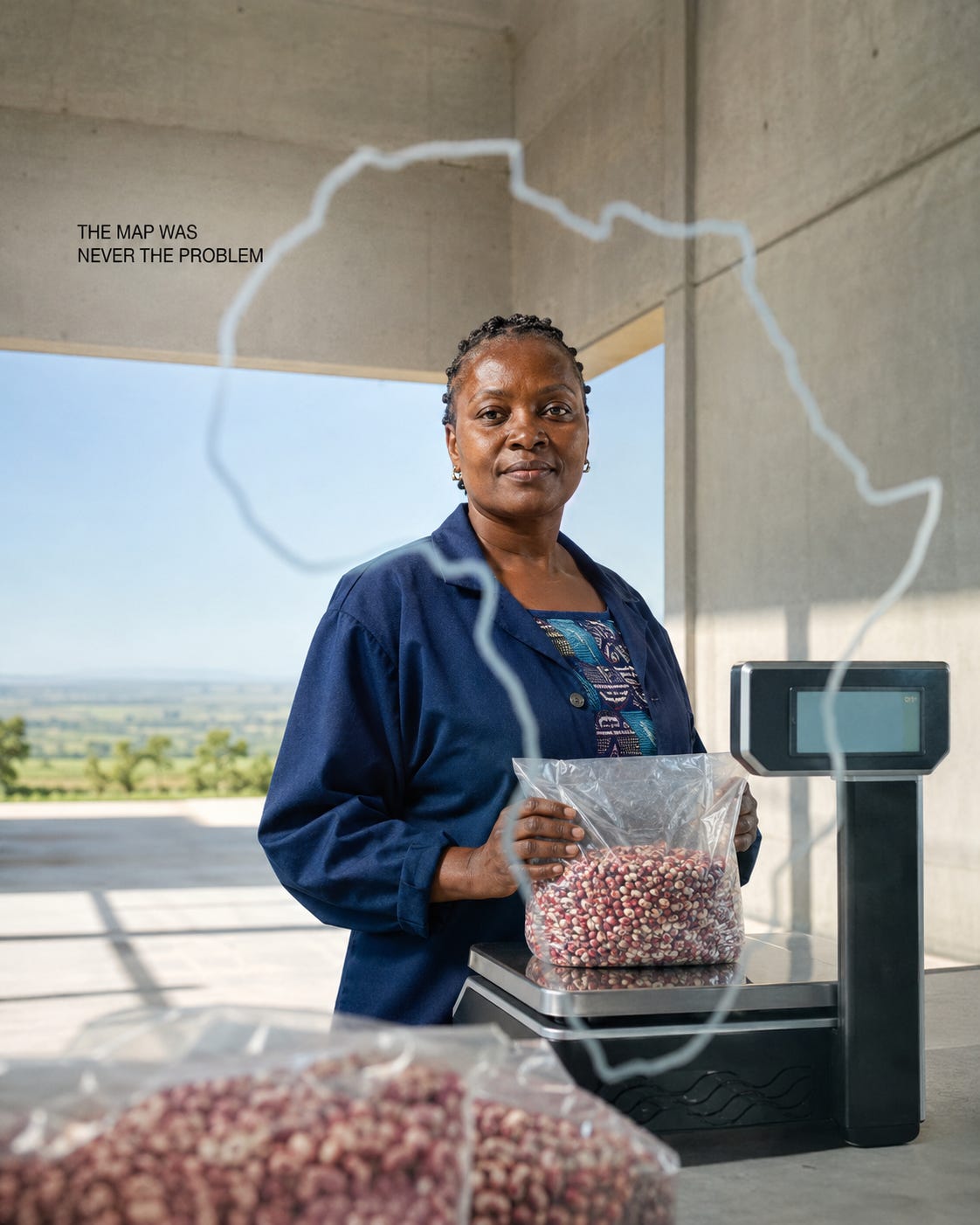
Today the UN General Assembly is voting on a resolution that asks the world to stop defaulting to the Mercator projection. Togo brought it forward, with the backing of the African Union, and the case is hard to argue with on the facts. The Mercator map, drawn in 1569 to help European sailors navigate, distorts landmass more the further it sits from the equator. It makes Greenland look roughly the size of Africa. Africa is around fourteen times larger. It makes Alaska look bigger than Mexico, which is also false. The countries that get visually inflated are, overwhelmingly, the wealthy ones. The continent that gets shrunk is the one that has spent decades fighting the perception that it is smaller, poorer and less central than it actually is.
The alternative on the table, the Equal Earth projection, was developed in 2018 by an international team of cartographers specifically to preserve true relative size. As Togo’s foreign minister put it in briefings ahead of the vote, a map is never neutral. It shapes how people read the relative importance of the places on it before they’ve engaged with a single fact.
I think that’s correct, and I think the resolution is worth supporting. I also think it’s important to say plainly what it does and doesn’t do, because the difference is the entire story I actually want to tell.
The resolution doesn’t ban the Mercator map. It doesn’t require governments, schools or companies to switch. It recommends. Which means the most likely outcome, even if it passes with strong support, is that some institutions update their defaults and most quietly don’t, because updating a default costs something and recommendations rarely force anyone to pay it.
I recognize that gap. I live inside a version of it every week.
At MOTHERLAND, the work we do with smallholder farmers in Kenya runs into the exact same pattern, just with different currency. Everyone in the sustainability and development sector agrees, in principle, that smallholder farmers capture too little of the value their production creates. You can say this in any funder meeting and get nods. It costs nothing to agree with it. The actual pricing structures that determine what a farmer earns for a kilo of beans, or what happens to a harvest of sweet potatoes with no cold storage and no negotiating leverage, don’t move an inch just because everyone in the room agrees the picture is unfair.
What moves it is someone deciding to set and pay a different price. Deliberately, before the production capacity is even built out, because if you build capacity first and leave the market structure to sort itself out, the market actors who are already positioned to extract value will fill that space faster than anyone else can. We learned this directly. It’s the reason our bean value chain looks structurally different from most of what farmers have access to elsewhere: we didn’t wait for the market to become fair on its own, because it doesn’t, and we didn’t treat fair pricing as a downstream nice-to-have once the “real” agricultural work was done.
That’s the pattern I keep seeing repeat itself across very different domains. A more accurate representation gets built, gets celebrated, and gets treated as the finish line, while the mechanism that was actually producing the distortion in the first place, the pricing, the funding flows, the market access, stays completely untouched underneath it.
Correcting the map matters. It resets what an entire generation of policymakers, educators and investors will carry as a visual default, and defaults are powerful precisely because nobody questions them. I don’t want to undersell that.
But I also don’t want to watch this become another example of the sector doing the easy, visible correction and calling it structural change. The test isn’t whether the map gets redrawn today. The test is whether, five years from now, the capital, the trade terms and the market access that flow toward the African continent have shifted anywhere near as much as the picture just did.
That’s the question I’d rather the sector sit with, instead of the size of Greenland.